

 English
  中文简体
中文简体 
What Makes PET Film the Industry Standard for Clarity, Strength, and Barrier Performance?
 2026.08.13
 Industry News
What Is PET Film? Understanding the Polyester Base
PET film is a biaxially oriented plastic substrate made from polyethylene terephthalate resin, a thermoplastic polyester formed through a polycondensation reaction. During manufacturing, molten resin is extruded into a flat sheet, then stretched in both the machine direction and transverse direction. This stretching process, known as biaxial orientation, realigns the polymer chains and produces a film with a balanced combination of mechanical strength, dimensional stability, and optical clarity that few other plastic substrates can match.
So what is polyester film in practical terms? It is essentially the same material family as PET fibers used in textiles, but processed into a thin, flat sheet form suitable for packaging, printing, insulation, and industrial lamination. Because the base resin is chemically inert and moisture resistant, polyester film has become the default carrier layer for metallized packaging, flexible electronics, and high-barrier laminates.
Unlike polyolefin films such as polyethylene or polypropylene, PET film does not rely on additives for rigidity. Its crystalline structure alone provides a stiffness-to-thickness ratio that allows converters to run thinner gauges without sacrificing machinability on high-speed printing and laminating lines. This is one reason PET film sheets are frequently specified in applications where both toughness and a smooth printable surface are required simultaneously.
Core Physical and Optical Properties of Polyester Film
Before selecting a film grade, converters typically review a standard set of physical characteristics. The table below summarizes the properties most commonly referenced when comparing polyester film lots or qualifying a new supplier's stock.
| Property | Typical Range | Test Reference |
| Density | 1.38 - 1.40 g/cm3 | ASTM D1505 |
| Tensile Strength (MD/TD) | 180 - 250 MPa | ASTM D882 |
| Elongation at Break | 70 - 150 percent | ASTM D882 |
| Haze (Clear Grade) | 1.0 - 3.5 percent | ASTM D1003 |
| Service Temperature | -60C to 150C | Internal thermal test |
| Water Vapor Transmission | 10 - 20 g/m2/day | ASTM F1249 |
These values vary by resin grade, stretch ratio, and post-treatment, but they form the baseline that most technical data sheets are built around. Clarity and tensile behavior in particular tend to shift together with thickness, which is why gauge selection deserves its own discussion.
PET Film Thickness: How Gauge Affects Performance
PET film thickness is typically expressed in microns and ranges from as thin as 9 microns for capacitor-grade dielectric film up to 350 microns or more for rigid sheet stock used in thermoforming trays. Thickness selection is rarely arbitrary; it is driven by the mechanical demands of the downstream process and the end-use environment.
Thin gauges around 12 to 23 microns are common in flexible laminates where the film acts as a barrier or metallizing carrier layer, and where minimizing overall laminate bulk matters for cost and flexibility. Mid-range gauges from 36 to 50 microns are favored for printed labels and pouch structures that need to survive handling and printing tension without stretching unpredictably. Heavier gauges above 75 microns move into rigid or semi-rigid applications, including protective overlays and industrial insulation, where puncture resistance becomes the priority over flexibility.
Optical Clarity and Barrier Performance Across Film Types
The optical clarity of polyester film is one of its most valued attributes, particularly for clear PET film sheets used in visible packaging windows and optical overlays. Haze values in premium clear grades stay below 3 percent, allowing near-glass transparency without the weight or brittleness of glass substrates. As thickness increases, haze tends to rise slightly because there is more material volume for light to scatter through, though the increase is gradual rather than linear in most production ranges.
Transparent barrier performance is a separate but related consideration. Uncoated PET film provides moderate resistance to oxygen and moisture, but its barrier properties improve substantially once it is metallized or coated with an inorganic oxide layer, without sacrificing the transparency that clear film applications require. This combination of visual clarity and enhanced barrier is why transparent barrier films built on a PET base are widely used in food and pharmaceutical packaging where product visibility matters as much as shelf life.
Heat Resistance and Tensile Strength: A Comparative View
Heat-resistant PET is one of its defining advantages over common polyolefin films. Where polyethylene begins to soften near 100C and can distort under moderate heat exposure, oriented PET film maintains dimensional stability up to roughly 150C for short-term exposure, making it suitable for retort pouch structures, hot-fill packaging, and lamination processes that involve heat-activated adhesives or extrusion coating.
Tensile strength of polyester film also outperforms most flexible packaging substrates on a thickness-adjusted basis. Because the polymer chains are stretched and aligned during biaxial orientation, the film resists tearing and stretching under the tension applied by high-speed printing presses and slitting equipment. This mechanical stability reduces web breaks and registration errors during conversion, which is a major reason PET is chosen as a carrier layer even when the final structure relies on other materials for sealing or softness.
How Chemically Treated PET Film Is Produced
Raw PET film has a relatively low surface energy, which makes it difficult for inks, adhesives, and coatings to bond securely without additional processing. Chemically treated PET film solves this problem by applying a thin primer or corona-modified surface layer during production, which raises surface energy and improves wettability before the film ever reaches a printing press or laminator.
The production sequence generally follows a consistent set of stages, moving from raw resin through orientation and finally to surface modification and quality verification.
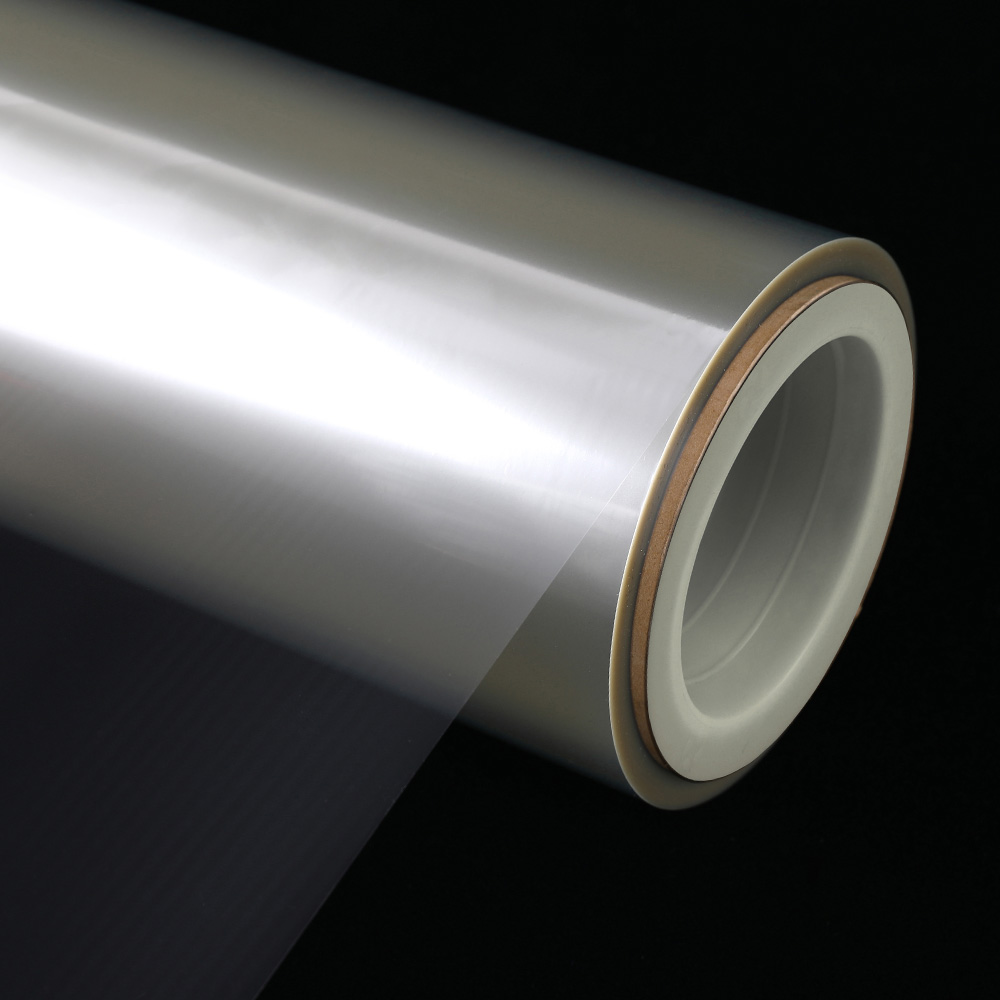
The chemical treatment stage is typically applied to only one side or both sides depending on the intended lamination structure. Single-side treated stock is common for print-and-laminate applications, while two-side treated film supports structures that require adhesion on both surfaces, such as double-sided coated barrier laminates.
Reading a PET Film Technical Data Sheet (TDS)
A PET film technical data sheet is the primary reference document converters use to confirm a roll meets processing and end-use requirements before it enters production. A well-prepared TDS reports mechanical values separately for the machine direction and transverse direction, since oriented film is not isotropic and behaves differently along each axis.
Beyond mechanical values, a complete PET film TDS should include haze and gloss readings, thermal shrinkage at a specified temperature, coefficient of friction, and surface treatment level expressed in dyne units. Converters comparing multiple rolls should always request test conditions alongside the raw numbers, since values measured under different humidity or temperature conditions are not directly comparable.
Selecting Clear PET Film Sheets for Your Application
Choosing the right PET film sheets comes down to matching gauge, treatment, and optical grade to the mechanical and visual demands of the finished product. The table below outlines common selection scenarios and the attributes typically prioritized in each case.
| Application | Priority Attribute | Typical Grade |
| Retort Pouch Laminate | Heat resistance | Treated, 12-16 um |
| Metallized Barrier Film | Barrier performance | Untreated core, 12 um |
| Printed Label Face Stock | Tensile stability | Treated, 36-50 um |
| Clear Packaging Window | Optical clarity | Untreated clear, 25-50 um |
| Protective Overlay Sheet | Puncture resistance | 75-125 um |
For visible packaging windows, low haze and high gloss take priority since any distortion is immediately noticeable to the end consumer. For structural or barrier-focused laminates, mechanical stability and treatment level matter more than absolute transparency. Reviewing a sample TDS against these priorities before committing to a production run helps avoid mismatched material selection later in the process.
Frequently Asked Questions
Q1: What is PET film used for in packaging?
It is primarily used as a barrier or structural layer in laminates, as a printable face stock for labels, and as a clear window material in flexible packaging where visibility of the product is required.
Q2: What is polyester film's typical shelf life once converted into packaging?
The film itself does not degrade quickly under normal storage conditions, but the shelf life of a finished laminate depends on the adhesive, sealant layer, and storage environment rather than the PET substrate alone.
Q3: How does PET film thickness affect stiffness?
Stiffness increases with thickness in a roughly proportional way for a given resin grade, which is why thicker gauges are chosen when structural rigidity is more important than flexibility.
Q4: Is chemically treated PET film necessary for all laminates?
Not always. Untreated film performs well in structures bonded through extrusion lamination, but surface treatment is generally required when solvent-based adhesives or water-based inks are used.
Q5: What information should a PET film TDS always include?
At minimum it should report tensile strength, elongation, haze, thermal shrinkage, and surface treatment level, each specified with the test method and conditions used.

Are you ready to work with us?
Start a project
- Quick Links
- Company Profile
- Company Culture
- Qualification
- FAQ
- Product
- ALOx Films
- VMPET
- VMCPP
- VMBOPP
- Coated Film
- Contact Us
- Tel: +86-13456263964
-
Phone : +86-0573-87783633
Phone : +86-0573-87780583 - E-mail : [email protected]
- Address: 6th Xinhe Road, Xieqiao Town, Haining City, Zhejiang Province, China

